
At Frank Holmes Fine Decor our expertise is in the restoration of Lincrusta and other raised relief wallpapers, made in Britain, dating from the 1870s to 1939. We have learned that the major wallpaper manufacturers, including Lincrusta, engaged the top designers of the day to keep up with the latest fashions spanning the Arts & Crafts era, more on that below.
These new ‘modern’ relief decorations, introduced in the late 19th century, were designed to replicate:
1877 –
Lincrusta-Walton
1882 –
Scott Morton Tynecastle Tapestry
1886 –
Lignomur
1887 –
Anaglypta
1888 –
Cameiod (a light-weight low relief Lincrusta-Walton product)
1890s –
Cordelova
1895 –
Salamander
Lincrusta-Walton wallcoverings (as they were first known), were developed and brought to market in 1877. First manufactured on the banks of the River Thames by Frederick Walton (the creator of Linoleum) and shown at trade exhibitions the world over. Top artists and designers of the day, including Dr Christopher Dresser, George C Haite and Owen W Davis, were employed to create a multitude of beautiful designs and to keep up with the latest trends throughout the Arts & Crafts era.
The Industrial Revolution meant that many decorative items for the home became more affordable and accessible to the masses. The Victorian middle classes, with aspirations and refined tastes, loved the versatility and practicality of Lincrusta – the first washable paper!
Following on from the success of Lincrusta, various alternatives came to market.
William Scott Morton was developing embossed wallpapers around the same time as Lincrusta came to market, then patented Tynecastle Tapestry imitation leather wallcoverings c.1882. Next was Lignomur from America in 1886, then Anaglypta in 1887. Cameoid was a low relief paper product introduced by Lincrusta-Walton Co in 1898. Cordelova started in Edinburgh in the 1890s. Salamander – a high relief material containing asbestos fibres promoted for its fire-retardant properties, was introduced in 1895, but production seized in 1901 when presses and rollers were taken over by Anaglypta, adding to their design range.
The English Arts and Crafts ideologies of Ruskin and Morris greatly influenced William Scott Morton. Initially William and his brother John worked in carved wood for furniture, wainscotting, fireplaces and other interior decorations. Inspired by embossed Italian and Spanish leather hangings following a European Tour, they patented Tynecastle Tapestry pressed canvas wallcoverings c.1882.
Prominent artists whose designs have been worked out in ‘Tynecastle’ include Sir J Burnett, Norman Shaw, H Baillie Scott and T E Collcutt. You can see a Tudor Rose design sample in the Cooper Hewitt, Smithsonian Design Museum, housed within the Andrew Carnegie Mansion, New York.
Frank was privileged to restore and refinish several of these historic wallpapers at The Langdale Chase Hotel, Windermere, Cumbria, during major renovations in 2023. The original Tynecastle Tapestry designs likely date c.1891 when Langdale Chase was originally built as a private family home on the shores of Lake Windermere. We identified each of their canvas friezes, borders and ceiling tile designs from our archive collection at Frank Holmes Fine Décor.
See some photos from the Langdale Chase Hotel project.
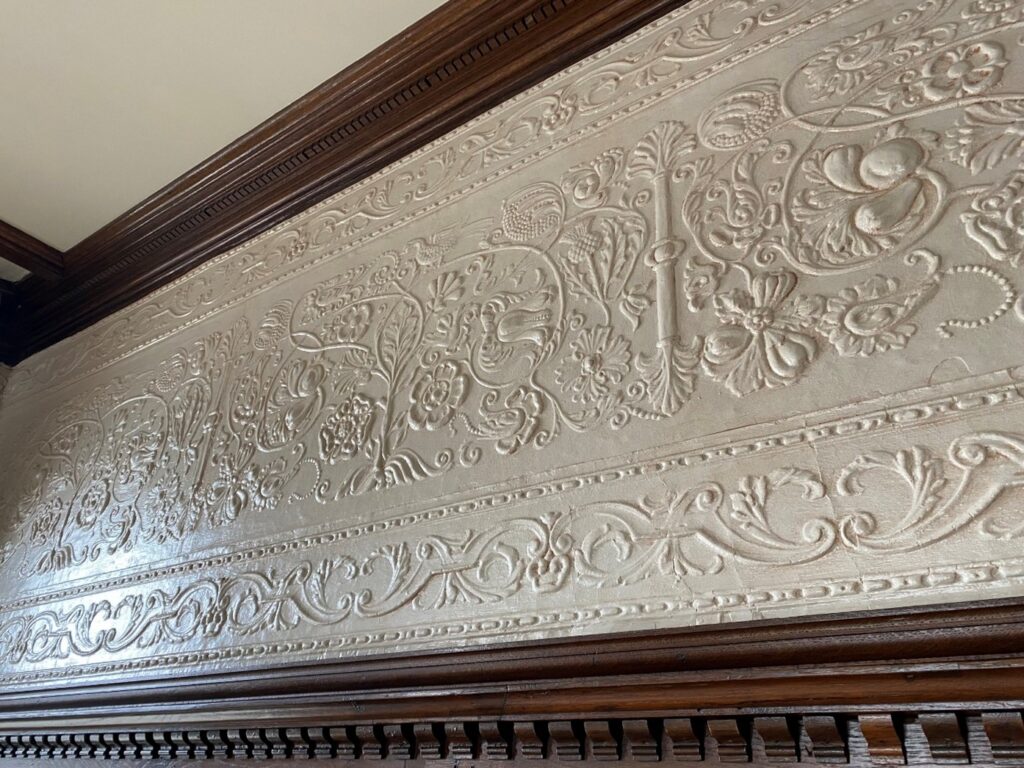
Tynecastle Tapestry canvas frieze in the style of Old Scotch Plaster, Langdale Chase Hotel, Windermere.
Anaglypta, was the biggest rival of Lincrusta-Walton.
By 1883 Thomas Palmer (then a London manager at Lincrusta-Walton) had developed an embossed paper pulp product which was lighter and cheaper than Lincrusta, but Mr Walton didn’t take it up. So, Mr Palmer left and in 1887 patented Anaglypta.
Partnering with The Storey Brothers of Lancaster, Anaglypta went into production the following year at Queens Mill, Lancaster. By 1894 production was relocated to Potters Mill, Darwen, also in Lancashire, and was later incorporated into the Wallpaper Manufacturing Company, as was Lincrusta-Walton.
Wallpaper Manufacturers Ltd (WPM) was incorporated as a joint stock company in 1899, merging the interests of 31 firms, who between them controlled up to 98 per cent of the British wallpaper market, including Anaglypta, Cordelova, Salamander and Lignomur. The Frederick Walton & Company (Lincrusta) was acquired by 1905. At first each individual company kept their own identity, but by 1920 Anaglypta, Lincrusta-Walton high relief and Cameiod low relief wallcoverings were marketed together, and produced in Darwen, Lancashire, with many designs made available in either product.
Dr Christopher Dresser, George C Haite, C F A Voysey, and Owen W Davis were some notable freelance designers of Lincrusta and Anaglypta. They had many contemporaries who worked in decorative art styles, spanning from the Aesthetic Movement, through Art Nouveau to the beginnings of the Art Deco period.
Dr Christopher Dresser (1834-1904) was a celebrated architect and designer associated with the design reform movement and industrial design in many mediums. Dresser created some early Lincrusta designs, including a floral design from a surviving Lincrusta-Walton red catalogue, a fragment of which, first installed in the New York Mansion of J D Rockefeller, is now preserved at the Cooper Hewitt. Dresser was a protégé of Owen Jones (1809-1874), himself an architect and designer, and one of the most influential design theorists of the 19th century.
George C Haite, RBA(1855-1924) was a fellow and/or president of numerous art societies, including acting as President of the Society of Designers, the National Association of House Painters & Decorators and The Japan Society, London. Haite was co-author of this trade catalogue collection of special Anaglypta designs for the Exposition Universelle Internationale, Paris, in 1900.
Through our work we love to learn more about the history and designers behind these wonderful old wallpapers and have a growing archive collection of our own and access to company archives.
Sadly, many heritage Lincrusta and Anaglypta designs were discontinued after 1939 because production rollers were melted down for the war effort. Later, Lincrusta developed a restoration kit. This enables approved restorers like Frank to make a mould from a sound section of your original design, and replicate additional panels as needed in repeats of up to 1 square metre. This method is suitable for other similar raised relief wallpapers, dados, friezes, and ceilings.
If your lovely vintage Lincrusta or Anaglypta has suffered some damage, perhaps from water ingress or building work, don’t despair. If your design is discontinued help is at hand! Contact us to see how we can help and take a look at out residaention and commercial restoration pages to see examples of our previous projects.